
By Celine Gross, Data Collective organiser and data scientist at Social Finance
A lot of my work with the Data Collective is about supporting organisations to share their data with others. This tends to surprise people: why would charities and service delivery organisations want to share their data with one another? Wouldn’t this be dangerous / complicated / not a priority (tick all that apply)?
Why sharing data with other organisations matters
By now, most people in the charity sector are convinced that good use of data enables better insights, and that better insights inform better services. But what if you’re a small organisation with a limited amount of data? Or an organisation that supports people with a specific need, and has only a partial view of your beneficiaries’ broader circumstances and challenges?
Pooling data together with others is a great opportunity to get a more comprehensive picture of people you serve. And it doesn’t need to be complicated…
How do you do it?
That’s the question we tackled in this morning’s workshop on ‘Sharing data, between charities, to better understand needs’.
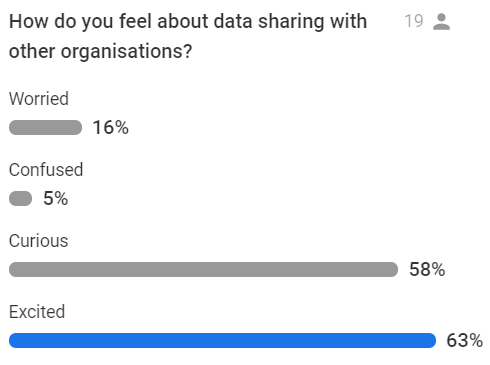
We had a group of about 25 participants from a diverse range of organisations: from large charities to smaller, community-based organisations. A quick pulse check showed us that most people were excited and curious about sharing data with other organisations – a great place to start!
Step 1: Get inspired by what others are already doing
We dedicated the first hour of the workshop to getting inspired. It’s hard to know where to start when you don’t know what is possible, so hearing about innovative projects from charity peers can be the spark that gets you started. We were lucky to showcase two inspiring projects:
- Safelives gets multiple agencies to share data with them, to better understand perpetrators’ complex situations through the Drive project
- Access Social Care and Mencap pool several helpline datasets together to pick up trends across England and identify when Local Authorities are acting unlawfully
Step 2: Get targeted help on the challenges that stop you from progressing
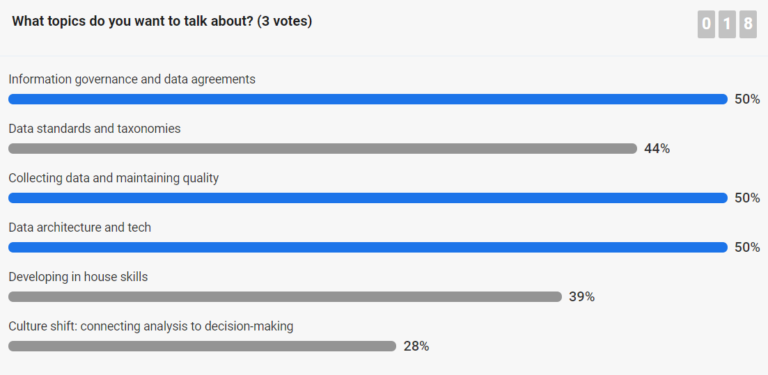
The second hour looked into practical challenges that could prevent an organisation from sharing their data with others. Participants had an opportunity to vote for topics they wanted to discuss.

In small groups, participants shared their challenges and discussed potential solutions, with the support of an experienced member of the Data Collective.
We talked about:
- Information governance and data agreements – how to develop data governance documents, and where the process can get stuck.
- Collecting data and maintaining quality – best practices, benefits of consistent data quality and how to develop a culture of data collection.
- Data architecture and tech – free tools and platforms, challenges of using tech and how to determine your data architecture strategy.
- Data standards and taxonomies – how to use existing well-established taxonomies and convince others to do the same.
What’s next?
This workshop gave us great insights into what organisations need. Resources and support on data standards, data agreements and open-source tools seem like obvious next steps. But there is also an appetite for the Data Collective to continue organising workshops to bring charities together, creating a safe space to seek help and find others to join forces with.
Community round up
- Our survey: The Data Collective survey is an opportunity to shape the Data Collective while in its pilot phase. All are welcome from charities and other civil society organisations — whether you’re ready to share and use data, or your interest in data sharing is more nascent. It takes 10-15 minutes to do. Please share your thoughts and pass the survey on to others that you think would be interested.
- Community call: The next Data Collective Community Call on Thursday 4 March is about ‘Resources’. We will look at common resources, resources you can share, and what we can create. Join the Community Call.
- Workshop: On 4 March, DataKind UK’s Data Science Lead Dulcie Vousden is running a workshop with Coalition for Efficiency called ‘Using data as a small organisation’. She’ll talk about some case studies of how small social change organisations have increased or understood their impact with data.
- Training and Support: Superhighways helps small charities and community groups in London do more with digital and data. They offer advice, training and support to help the sector be more effective, work smarter, raise their profile and demonstrate their impact using digital and data.