
by Sam Milsom, Programme Development Manager at Open Data Manchester
Street League is a large charity that uses sport and education to help young people into work. It uses sport to engage them, while teaching essential life skills, including alternative pathways through education, help with employment applications and workplace skills, while also tackling their wellbeing and fitness.
Dr Lindsey Macdonald is Managing Director at Street League and has been there since 2014. She says that data was built into the culture of the organisation before she came on board. The charity’s founder had been an Accident and Emergency doctor, and so “with this science-based mind he was just interested in data collection and objective quantitative information”.
“I think it’s fair to say that the earliest steps might feel like the shortest ones. There’s an element of ‘the hard yards are done at the beginning’, because it’s about the small processes that you put in place, which then you later build on, refine, make more efficient; and that’s where you get the catalyst of progressing your data journey.”
As a charity centred around sport, Street League leverages that mindset to build and embed a strong performance culture, and this is clearly reflected in its approach to data. Lindsey says that early funding was awarded to the charity based on how many young people were successfully supported, and so from an early stage, information around KPIs needed to be at the forefront. As the charity grew, more offices opened across the country and leadership became regionally dispersed, so data sharing became imperative to the day-to-day running of things.
“What we have is 13 offices across the UK, with a Data and Insight Team in one, leadership and team members spread across different offices. So all of a sudden, sharing data in a report is just an obvious thing that you need to do.”
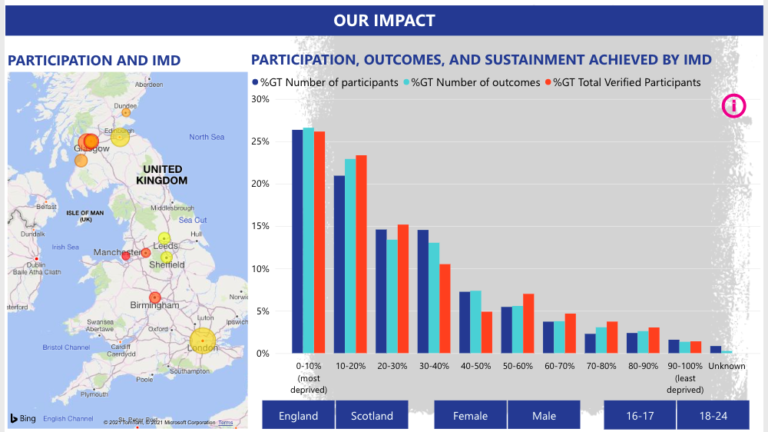
Some of the data the organisation collects includes the number of young people engaged with, how many have since disengaged, how many of them progress into employment and whether or not that employment is sustained. The organisation has a strong commitment to transparency and accountability, and has developed an impact dashboard that allows anyone to track the progress of the organisation – good and bad. Lindsey says, because of the charity’s performance culture and leadership buy-in surrounding data, there was very little resistance to opening up the data in this way.
One challenge that Street League has worked hard to overcome is around making data collection a priority. Many of their staff work face-to-face with young people in communities, classrooms or in the workplace. For them, their priority and their motivation is not data — it’s the young people they’re supporting.
For many in the social sector, data is an abstract thing. Without real-world context, disinterest at the mention of the word is not uncommon. At Street League, past attempts to champion and talk about data simply hadn’t worked. Lindsey says there was little progress “even when they were brilliant ideas… Because they talked about ‘data’ – and nobody else really likes data”.
Likewise, bringing in external experts to carry out data workshops was considered difficult, because the experts often still use language and terminology that can feel inaccessible to ‘non data’ people.
It’s of primary importance for Street League to collect the right data to help track the success of its programmes and to ensure the right support is being given, and it’s those front-line staff who are doing the collecting.
The approach Street League has taken is to ensure data collection is aligned with the young people, who are ultimately the priority and motivation. Staff don’t talk about data as being data – they even avoid using the word. Staff are not asked to collect data or record KPIs. They focus on the young person’s achievements, or whether they remained in employment or moved to a new opportunity. By asking for and recording this sort of information, they are on the one hand collecting important data, but on the other, it’s all part of the support they give to young people.
In turn, this same information, which is used to record and report their impact, is fed back to staff in similar ways. They have conversations about when young people stick with jobs in a certain sector and why that might be, for example.
“They get the data back, but it’s given to them in conversation around what it means for young people.”
For the staff working directly with young people, what matters is the human behind the data – the barriers they may be facing, their achievements. This is the data, even though they don’t always realise it.
Street League consciously chooses to communicate data in a way that keeps the focus on the young person. And in doing so, it opens up conversations around what works, what adds value to what the organisation is doing, or how things might be done differently.
For example, noticing that some young people might seem to have disengaged from the programme, but they then return at a later date. Street League knows it needs to change the way it records and reports these experiences. And this means changing its data architecture, along with data workshops with front-line staff.
“We’re doing a big piece of work at the moment around our disengagement. And it’s all metrics. It’s all KPIs, like, mind-bending data science… But all of the staff are engaging and loving these. You might call them data workshops, but what we’re calling them is, you know, ‘how to better support young people’.”
Street League began with a strong data culture at the top-level. But, as the organisation’s main data collectors, it was vital to have this aligned with the priorities and motivations of front-line staff. It achieved this, not necessarily by drilling data principles into them, but communicating in a way that kept the focus on the support they were giving directly to young people, in simple and accessible language. And Lindsey says this is key:
“The world of data, in the way that we actually capture and use data, is not data. It’s young people. It’s what barriers they face, the support that they need, what achievements have been met and reached. And that’s the thing I always say to ‘data people’ – ‘just stop talking about data’.”
This case study informs part of a report, ‘How the Social Sector is Overcoming Cultural Barriers Around Data Use to Transform the Services it Provides to the People Who Need Them Most’ by Open Data Manchester, in collaboration with Catalyst, to understand how the use of data is transforming the social sector. Find out more and download the full report here: